


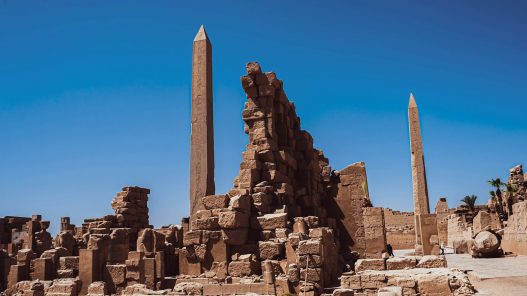
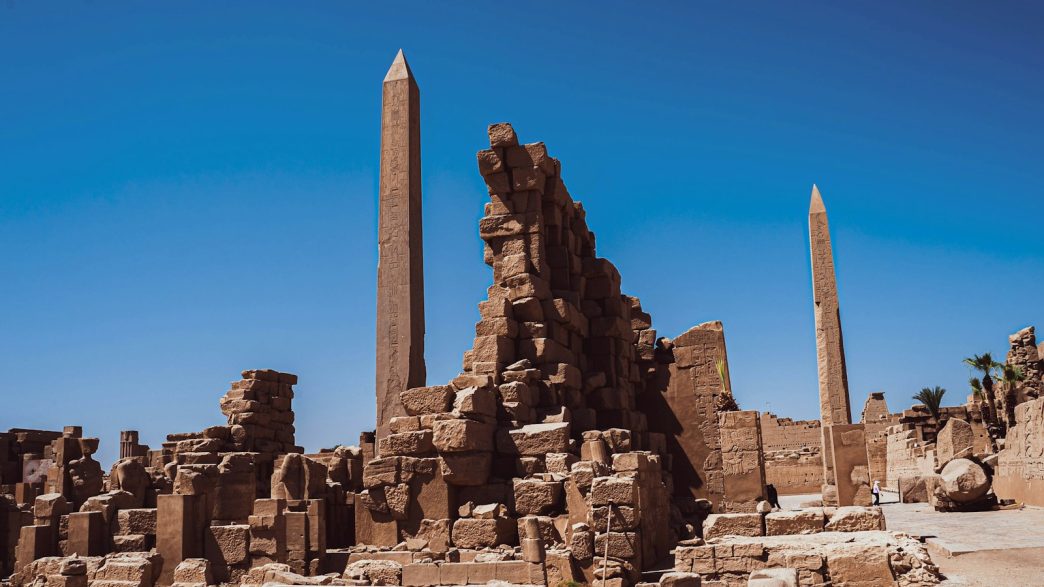
The best-known Egyptian obelisks outside Egypt stand in Rome, which has eight, and in Paris, London, New York and Istanbul; inside Egypt the highlights are Karnak, Luxor, Heliopolis and Aswan.
This guide lists, city by city, which pharaoh commissioned each obelisk, how tall it is and when it was moved, plus practical tips for seeing them on a trip. The facts were checked in October 2026 against official and heritage sources: Turismo Roma, the French Ministry of Culture, Egypt’s Ministry of Tourism and Antiquities, Historic England, the London Museum, the Central Park Conservancy and Encyclopaedia Britannica. Heights are approximate and refer to the monolith without its pedestal.
What Egyptian obelisks are and what they were for
Egyptian obelisks are single blocks of stone with a square cross-section that taper to a small pyramid at the top, called a pyramidion. The Egyptians called them tekhen and linked them to the cult of the sun, above all to the god Ra.
They usually stood in front of temple entrances, often in pairs, like the two that Ramesses II placed before the pylon of Luxor Temple. The hieroglyphs on their faces dedicated the monument to the gods and praised the pharaoh who had ordered it. The pyramidion was sometimes covered in gold or electrum, a natural alloy of gold and silver, to catch the sunlight.
The stone came from granite quarries such as those at Aswan, in southern Egypt. According to Encyclopaedia Britannica, an inscription on the base of Hatshepsut’s obelisk at Karnak says that cutting it out of the quarry took seven months. Reliefs in Hatshepsut’s temple at Deir el-Bahari, cited by Egypt’s Ministry of Tourism and Antiquities, show obelisks being shipped along the Nile to Karnak.
Table of Egyptian obelisks outside Egypt
Outside Egypt, the most visited ancient Egyptian obelisks are in Rome, Paris, London, New York and Istanbul. The table shows where to find them, which pharaoh commissioned them, their approximate height and when they reached their current site.
| City | Location | Pharaoh (origin) | Approx. height | Moved |
|---|---|---|---|---|
| Rome | Piazza di San Giovanni in Laterano | Thutmose III (Karnak) | 32 m | Brought to Rome in 357 by Constantius II; on its current site since 1588 |
| Rome | St Peter’s Square, Vatican | No hieroglyphs, pharaoh unknown | 25.5 m | Brought to Rome in AD 37 by Caligula; in the square since 1586 |
| Rome | Piazza del Popolo | 13th century BC (Heliopolis) | 24 m | Brought by Augustus in 10 BC; in the square since 1589 |
| Rome | Piazza di Montecitorio | Psamtik II (Heliopolis) | 21.8 m | Age of Augustus; in the square since 1792 |
| Rome | Piazza della Rotonda, in front of the Pantheon | Ramesses II (Heliopolis) | 6 m | Age of Domitian; in front of the Pantheon since 1711 |
| Rome | Piazza della Minerva | Apries (6th century BC) | 5.5 m | Age of Domitian; on Bernini’s elephant since 1667 |
| Paris | Place de la Concorde | Ramesses II (Luxor Temple) | 23 m | Offered to France in 1829; raised in 1836 |
| London | Victoria Embankment, by the Thames | Thutmose III (Heliopolis) | 21 m | Given in 1819; raised in 1878 |
| New York | Central Park, next to the Metropolitan Museum | Thutmose III (Heliopolis) | 21 m | Raised in 1881 |
| Istanbul | Sultanahmet Square (former Hippodrome) | Thutmose III (Karnak) | Only the upper part survives | Raised in 390 by Theodosius I |
Rome also has two small obelisks of Ramesses II, one in Villa Celimontana and one at the Dogali monument near Termini station. The table leaves out the obelisks that Romans carved in imitation of Egyptian ones, such as the one in Piazza Navona.
Rome, the city with the most Egyptian obelisks
Rome has more obelisks than any other city: the official Turismo Roma leaflet counts 14, and eight of them are ancient Egyptian. The rest were carved in Roman times in imitation of Egyptian models, apart from one at Villa Medici, which is a 19th-century copy.
The first ones arrived after Rome conquered Egypt in 30 BC. Augustus brought the obelisk now in Piazza del Popolo from Heliopolis and set it up in the Circus Maximus; the Montecitorio obelisk served as the pointer of a huge sundial on the Campus Martius. Caligula brought the Vatican obelisk in AD 37 for the circus later known as Nero’s, and Constantius II added the Lateran obelisk in 357, originally commissioned by Thutmose III for the temple of Amun at Karnak.
Over the centuries many of them fell, broke or were buried. Pope Sixtus V hired the architect Domenico Fontana to raise them again: the Vatican obelisk in 1586, in an operation that took about four months, the Esquiline one in 1587, the Lateran one in 1588 and the Piazza del Popolo one in 1589. Turismo Roma explains that he used them as landmarks for pilgrims at the end of new straight streets linking the basilicas.
The Lateran obelisk is the tallest in Rome, with a 32.18-metre monolith and 45.70 metres including pedestal and cross. Encyclopaedia Britannica describes it as the largest ancient obelisk still in existence.
Paris, London, New York and Istanbul
The Egyptian obelisks in Paris, London and New York left Egypt in the 19th century as diplomatic gifts from Egypt’s rulers, while the one in Istanbul arrived in the 4th century on the orders of a Roman emperor.
Paris: the Luxor obelisk on Place de la Concorde
The obelisk on Place de la Concorde is one of the pair Ramesses II raised in front of Luxor Temple: it is 23 metres tall, weighs 222 tonnes and dates from the 13th century BC, according to the French Ministry of Culture. The viceroy Muhammad Ali offered it to France in 1829, it sailed to France on the ship Louxor and it was raised on Tuesday 25 October 1836.
The gilded tip visible today is recent: a 3.60-metre bronze pyramidion fitted in May 1998. The monument was restored between January and June 2022. Some years after the gift, King Louis-Philippe sent Muhammad Ali a copper clock tower that still stands in the courtyard of the Muhammad Ali Mosque in Cairo’s Citadel.
London and New York: Cleopatra’s Needles
Cleopatra’s Needles are two obelisks that Thutmose III raised at Heliopolis around 1450 BC, roughly 1,400 years before Cleopatra’s reign. In Roman times they were moved to Alexandria and set up in front of the Caesareum, a temple linked to Cleopatra, which is where the nickname comes from.
The London needle was given to Britain in 1819 by Muhammad Ali but did not travel until 1877. It was raised on the Victoria Embankment on Thursday 12 September 1878 and is Grade I listed by Historic England. Historic England notes that Ramesses II added inscriptions about 200 years after it was made.
The New York needle was announced as a gift to the United States in 1879 and raised in Central Park on Saturday 22 January 1881. The Central Park Conservancy says the shaft is 69 feet (about 21 metres) tall, weighs around 200 tons and is the oldest outdoor monument in the city.
Istanbul: the Obelisk of Theodosius
The Hippodrome obelisk in Istanbul is a monument of Thutmose III from Karnak that Emperor Theodosius I had raised in AD 390. Only the upper part of the monolith survives, and it can be seen in Sultanahmet Square.
The Egyptian obelisks still in Egypt
Inside Egypt, Egyptian obelisks still stand at Karnak, at Luxor Temple and at Heliopolis, while Aswan keeps the huge unfinished obelisk, still attached to the bedrock.
| Site | Pharaoh | Approx. height | Status |
|---|---|---|---|
| Karnak (Luxor), temple of Amun | Hatshepsut | Almost 30 m, over 300 t | Standing, next to a smaller obelisk |
| Luxor Temple | Ramesses II | 25 m | Standing; its twin has been in Paris since 1836 |
| Heliopolis (Ayn Shams, Cairo) | Senusret I, 12th Dynasty (1956-1911 BC) | No official figure | Standing on the archaeological site |
| Aswan quarry | Attributed to Hatshepsut | 42 m if finished | Unfinished, never separated from the rock |
The obelisk of Senusret I still stands on the site of ancient Heliopolis, the great centre of sun worship, now in Cairo’s Matariya district. According to the Ministry of Tourism and Antiquities, many other obelisks from local temples were moved away by Greeks and Romans in antiquity.
The Unfinished Obelisk in Aswan would have been about 42 metres tall and weighed 1,168 tonnes, more than any other Egyptian obelisk. It is believed to have been commissioned by Hatshepsut for Karnak, but work stopped because of flaws and several fissures in the stone. Sand covered it until the early 20th century.
How to see Egyptian obelisks on your trip
The Egyptian obelisks in Europe and New York stand in public squares and parks, so you can see them for free at any time; the ones in Egypt are inside archaeological sites that charge admission.
- Rome: a walk through the centre links Piazza del Popolo, Montecitorio, the Pantheon and Piazza della Minerva, right behind the Pantheon. For the others, Turismo Roma lists metro line A stations Flaminio (Piazza del Popolo), San Giovanni (Lateran) and Ottaviano-San Pietro (Vatican).
- Paris: Place de la Concorde lies between the Tuileries Garden and the Champs-Élysées, with Concorde metro station (lines 1, 8 and 12).
- London: the needle is on the Victoria Embankment, a few minutes’ walk from Embankment Underground station, flanked by two bronze sphinxes.
- New York: it stands on the east side of Central Park, between the Great Lawn and the Metropolitan Museum of Art, so it pairs well with a museum visit.
- Istanbul: Sultanahmet Square covers the old Hippodrome in the historic centre and is easy to explore on foot.
- Egypt: Karnak and Luxor Temple are in the city of Luxor; the Unfinished Obelisk is in the Aswan quarries; the Senusret I obelisk is in Cairo’s Matariya district. Prices and opening hours change, so check the Ministry of Tourism and Antiquities website before you go.
The Buenos Aires Obelisco is not Egyptian
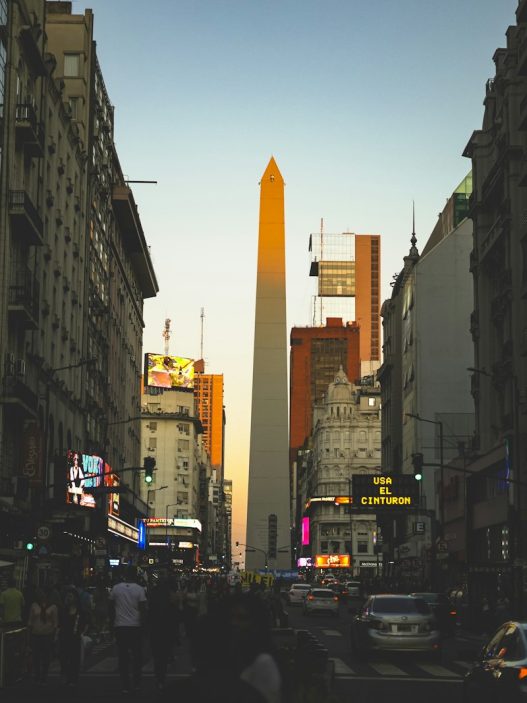
The Obelisco of Buenos Aires is a modern monument with no link to the pharaohs: it opened on Saturday 23 May 1936, was designed by the architect Alberto Prebisch and is 67.5 metres tall, according to the city’s official tourism site.
The Obelisco was built in just 31 days to mark the 400th anniversary of the first founding of Buenos Aires by Pedro de Mendoza in 1536. It stands where Avenida 9 de Julio crosses Avenida Corrientes, on the spot where the Argentine flag was first raised in the city. It borrows the shape of Egyptian obelisks, but it has no hieroglyphs and no ancient stone.
Dozens of colectivos (city buses) run along 9 de Julio or Corrientes, and our guide to Buenos Aires buses has the routes. For example, the S service of bus 8, which links Ezeiza and Aeroparque airports, passes along 9 de Julio by the Obelisco. All buses are paid with the SUBE card, and the guide to the SUBE card in Buenos Aires explains how to buy and top it up. If you travel in summer, see what to expect from Buenos Aires in December and January.
Frequently asked questions
How many Egyptian obelisks are there in Rome?
Rome has eight ancient Egyptian obelisks, more than any other city outside Egypt. The official Turismo Roma leaflet counts 14 obelisks in the city, but the rest were carved in Roman times in imitation of Egyptian ones or are modern copies. The largest Egyptian ones stand at the Lateran, the Vatican, Piazza del Popolo and Montecitorio.
What is the tallest Egyptian obelisk still standing?
The tallest is the Lateran obelisk in Rome, with a monolith of about 32 metres and 45.70 metres including pedestal and cross. Thutmose III commissioned it for Karnak, and it reached Rome in AD 357. Inside Egypt, the tallest standing obelisk is Hatshepsut’s at Karnak, at almost 30 metres.
Why are the London and New York obelisks called Cleopatra’s Needles?
They got the name because in Roman times they stood in Alexandria in front of the Caesareum, a temple linked to Cleopatra. In fact Thutmose III raised them at Heliopolis around 1450 BC, roughly 1,400 years before her reign. The London needle went up in 1878 and the New York one in 1881.
What is the Unfinished Obelisk in Aswan?
The Unfinished Obelisk is an obelisk left half-carved in an Aswan quarry because the stone had flaws and several fissures. Finished, it would have been about 42 metres tall and weighed 1,168 tonnes, according to Egypt’s Ministry of Tourism and Antiquities. It is attributed to Hatshepsut and can be visited as an archaeological site today.
Is the Obelisco in Buenos Aires Egyptian?
No. The Obelisco of Buenos Aires is a modern monument opened on 23 May 1936, designed by the architect Alberto Prebisch for the 400th anniversary of the city’s first founding. It is 67.5 metres tall and stands at the junction of Avenida 9 de Julio and Avenida Corrientes, in the heart of the city.
Do you have to pay to see Egyptian obelisks?
In Rome, Paris, London, New York and Istanbul you do not have to pay, because the Egyptian obelisks stand in public squares and parks. In Egypt, Karnak, Luxor Temple and the Unfinished Obelisk in Aswan are inside archaeological sites with admission fees, so check current prices before your trip.
Cover photo: 2H Media / Unsplash