
A Day of the Dead ofrenda in Mexico is usually set up between Wednesday 28 and Saturday 31 October 2026, ready for the souls of children on 1 November and adults on 2 November, although the exact day depends on regional tradition.
Below you will find the 2026 calendar of souls day by day with weekdays, what goes on the altar and what each item means, when the ofrenda comes down, and what is open or closed on Monday 2 November. The information was checked on 8 October 2026 against publications by Mexico’s National Institute of Anthropology and History (INAH), the Ministry of Culture, ISSSTE, Profeco, the Ministry of Education (SEP) and UNESCO.
When to set up a Day of the Dead ofrenda in 2026
A Day of the Dead ofrenda goes up a few days before 1 November, and Mexico has no single official date for it. Each family and community follows its own calendar, passed down through generations.
Official sources document how much this varies. In Cuanajo, Michoacán, the Ministry of Culture recorded that the ofrenda must be in place from 28 October. In the Huasteca region, INAH notes that preparations for the Xantolo festival start about a month ahead.
The practical rule is simple. Families who receive the souls of people who died tragically set up the altar by Wednesday 28 October. Families who only welcome children and adults usually have it ready by Saturday 31 October.
The 2026 calendar of souls, day by day
The calendar of souls is a popular tradition that gives each group of the dead its own arrival day between 27 October and 2 November. UNESCO describes it this way: each deceased person has a specific day of worship based on the cause of death, age, sex and, in some cases, profession.
The most widely shared version is the one published by ISSSTE on gob.mx in 2025 (in Spanish). Dates and weekdays below are for 2026.
| Date 2026 | Who arrives, by tradition | Documented variations |
|---|---|---|
| Tuesday 27 October | Pets that have died | Recent custom, not followed everywhere |
| Wednesday 28 October | People who died tragically or in accidents | Profeco lists it as a custom of some places |
| Thursday 29 October | Souls with no one to set out an offering for them | The Huasteca’s Xantolo begins in late October |
| Friday 30 October | Lonely and forgotten souls | In some places, children who died unbaptised (Profeco) |
| Saturday 31 October | Souls in limbo and children who were never born | In Cuanajo, Michoacán, the children arrive; first day of the Maya Hanal Pixán, devoted to children |
| Sunday 1 November | Angelitos: children who died (All Saints) | In Cuanajo the adults arrive; Noche de Ánimas in Pátzcuaro |
| Monday 2 November | Adults (All Souls) | Farewell to the souls in many communities |
Treat the table as a reference for when the ofrenda goes up, not as a rule. The Ministry of Culture records other patterns: in Chicontepec, Veracruz, children arrive on 1 November and adults on 2 November, and the Otomí community of Cruz Blanca remembers those who died violently on 18 October, the feast of Saint Luke.
What goes on the ofrenda and what each item means
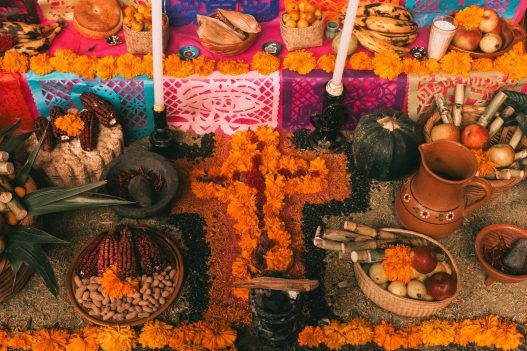
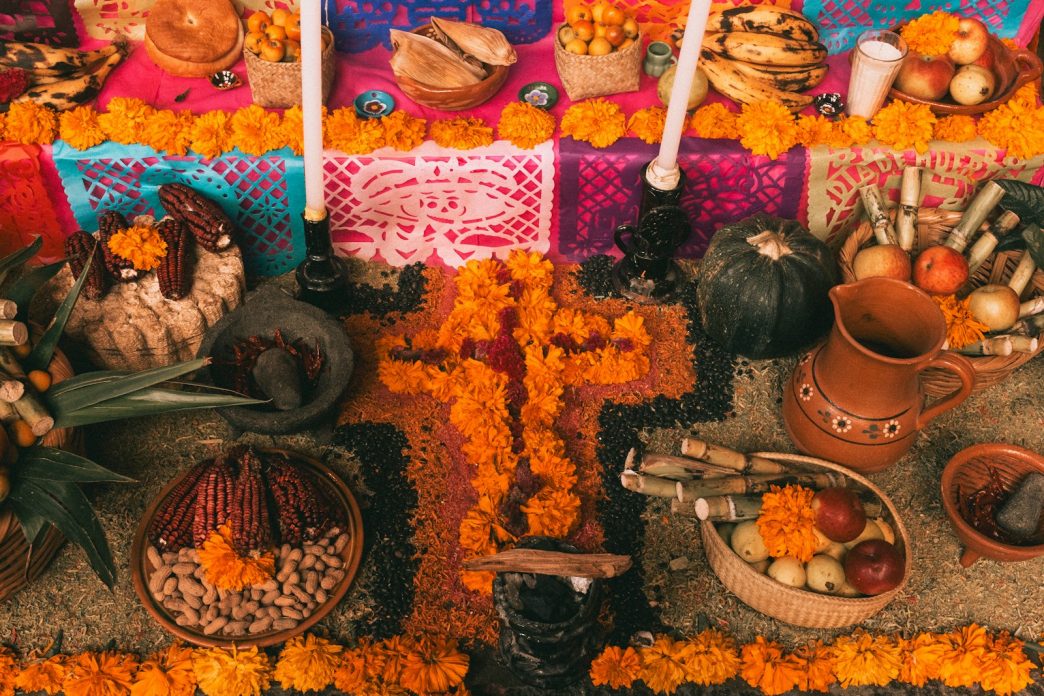
A Day of the Dead ofrenda holds water, salt, candles, cempasúchil marigolds, copal incense, pan de muerto, the person’s favourite food and a photograph, and there is no fixed number of items. The meanings below are the ones published by Profeco, the SEP and the Ministry of Agriculture.
| Item | Traditional meaning |
|---|---|
| Water | Quenches the souls’ thirst after their long journey |
| Salt | Purifies, so the body does not decay on its round trip |
| Candles | Light, faith and hope; they guide the souls home |
| Cempasúchil (marigold) | Its colour and scent guide the souls; petals mark a path to the altar |
| Copal and incense | Clear the space of bad spirits so the soul can enter safely |
| Pan de muerto | A fraternal offering and a sign of affection |
| Papel picado | Cut tissue paper that adds colour and represents air |
| Photograph | Identifies the person who is coming to visit |
| Sugar skulls | Represent death; small ones are part of the sweets for children |
| Favourite food and drink | So the visitor can enjoy what they liked in life |
| Petate (woven mat) | A resting place for the souls or a cloth for the food |
| Clay xoloitzcuintle dog | Helps children’s souls cross the river to Mictlán |
Many families add seasonal fruit such as tangerines, guavas, oranges and sugar cane, plus regional dishes like mole or tamales. Mexico City’s official tourism portal adds that white flowers are offered to children.
The ofrenda for children
Altars for children are often different from those for adults. In Yucatán, according to the Ministry of Culture, the children’s altar holds fruit, clay toys, bread and sweets.
Ofrenda levels: two, three or seven
Altar levels are a cultural interpretation rather than a rule, and the most common ofrenda has two levels representing heaven and earth. Three-level altars add a third plane that some sources describe as the underworld and others as purgatory.
Seven-level ofrendas are less common and are linked to the steps a soul must climb to reach rest. No official body sets a number of levels, so a simple table with the basic items is as valid as a seven-step altar.
When the ofrenda comes down
Most households take the ofrenda down after the adult souls are sent off on Monday 2 November 2026, either that night or in the following days. There is no official date for removing it.
Some communities keep the visit going much longer. In Chicontepec, Veracruz, the Ministry of Culture recorded that the dead stay with the living until 29 November, the feast of Saint Andrew, which falls on a Sunday in 2026.
If the food is real, ISSSTE advises not letting children eat it after several days on display. Many families use imitation bread and fruit to avoid mould and insects.
Is 2 November 2026 a public holiday in Mexico?
Monday 2 November 2026 is not a statutory rest day, because article 74 of Mexico’s Federal Labour Law does not include the Day of the Dead. For employers it is a regular working day unless they choose to give it off.
Schools do pause: the SEP 2026-2027 school calendar, published on 15 July 2026, lists 2 November as a day without teaching. Two weeks later comes Monday 16 November, a statutory rest day for the Mexican Revolution. You can plan ahead with Mexico’s public holidays for 2027.
Where to see traditional ofrendas in Mexico
The best-known Day of the Dead celebrations are in Michoacán, the Huasteca and the Yucatán Peninsula, and each follows its own calendar. INAH describes three of them.
- Pátzcuaro, Michoacán: Noche de Ánimas on the night of 1 November, with marigold arches, candles, copal and red-corn tamales; on Janitzio and in Tzintzuntzan the candles number in the thousands.
- Huasteca (Hidalgo, Veracruz, San Luis Potosí and Tamaulipas): Xantolo, with tamales, chocolate, pan de muerto and flowers.
- Hanal Pixán (Yucatán Peninsula): three days, the first devoted to children, with pibipollo offered to the souls. In Pomuch, Campeche, the bones of the dead are wrapped in white embroidered cloths.
UNESCO inscribed the Indigenous festivity dedicated to the dead on its Representative List of the Intangible Cultural Heritage of Humanity in 2008, after proclaiming it in 2003. If you are visiting Mexico City for the season, check how to get around on the Mexico City Metro and which payment methods work in Mexico at markets and flower stalls.
Safety checklist for your ofrenda
Place the ofrenda somewhere high and stable, away from curtains, electrical appliances, children and pets. ISSSTE recommends the following:
- Blow out candles when you leave the room or go to sleep.
- Keep candles away from curtains and papel picado.
- Put a little water in the candle holder to catch melted wax.
- Consider battery-powered candles, which are safer.
- Supervise children around candles, matches and lighters.
- Secure items so they cannot fall.
Frequently asked questions
When do you set up a Day of the Dead ofrenda in 2026?
Most families set up their Day of the Dead ofrenda between Wednesday 28 and Saturday 31 October 2026. Those who welcome the souls of people who died in accidents have it ready by the 28th, while those who only receive children and adults finish it by the 31st. There is no official date, and each region keeps its own calendar.
Which souls arrive on 28 October?
On 28 October, according to the popular calendar published by ISSSTE and Profeco, the souls of people who died tragically or in accidents arrive. In 2026 the date falls on a Wednesday. The custom is not the same everywhere in Mexico: some communities receive nobody that day, and Cruz Blanca, Veracruz, remembers violent deaths on 18 October instead.
When do children and adults arrive?
Children, called angelitos, arrive on Sunday 1 November 2026 and adults on Monday 2 November in most of Mexico. In some Michoacán communities such as Cuanajo, children arrive on 31 October and adults on 1 November, and all the souls are sent off on 2 November. Local timing varies, so ask your hosts.
When do you take the ofrenda down?
The ofrenda usually comes down after the adult souls leave on Monday 2 November 2026, that night or over the next few days. No official rule exists. In some areas, such as Chicontepec in Veracruz, the visit of the dead lasts until 29 November, the feast of Saint Andrew, so altars stay up for weeks.
What are the basic items of an ofrenda?
The basic items of an ofrenda are water, salt, candles, cempasúchil marigolds, copal, pan de muerto, papel picado, the person’s favourite food and a photograph. Official sources agree there is no required number of items, so each family builds the altar with what it has and with what the person enjoyed in life.
Is the Day of the Dead a day off in Mexico?
No, 2 November is not among the statutory rest days in article 74 of the Federal Labour Law, so for employers it is a regular working day. The SEP school calendar does mark Monday 2 November 2026 as a day without teaching in basic education, so many children have no classes that day.
Cover photo: Chris Luengas / Unsplash