




With the arrival of September, spring appears as a symbol of renewal. Throughout history, artists have utilized the seasons to capture the essence of time, exploring colors, climates, and transformations that alter the perception of the environment.
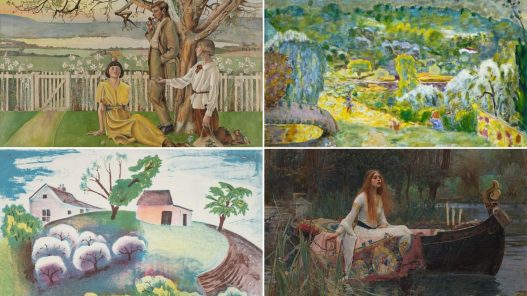
Landscapes have served as the backdrop for various cultural narratives, from the religious to the everyday. This selection of works includes four representative pieces from different styles and eras, all related to the theme of spring. Among them are Spring on a Hillside by Alexander Oja, A Spring Landscape by Pierre Bonnard, The Picnic by Christine Kühlenthal, and The Lady of Shalott by John William Waterhouse, each presenting characters within a landscape that complements and defines their story.
Spring on a Hillside (1941) by Alexander Oja depicts a green elevation dotted with buildings, with a path that opens to the right. This work, a color lithograph created for the Federal Art Project in Minnesota during the Great Depression, captures the transition from winter to spring through its use of soft tones and natural details. The National Gallery of Art in Washington possesses a copy of this work that is part of a limited edition of 25 copies.
A Spring Landscape, approximately from 1935, presents an elevated terrain overlooking a bridge over water and moving figures surrounded by vegetation. Pierre Bonnard’s technique avoids defined contours, favoring vibrant brushstrokes that create a perception of space rather than a literal representation. This work, also part of the collection of the National Gallery of Art, reflects the evolution of landscape in art, positioning it as a fertile ground for the exploration of color and visual memory.
The Picnic (1913) by Christine Kühlenthal depicts an outdoor gathering, a characteristic scene in British painting from the early 20th century, where nature becomes a vital space for social interaction. This piece fits within a context of transformation in British art, just before the outbreak of World War I, and allows us to interpret the countryside experience as an element of cultural identity.
Finally, The Lady of Shalott (1888) by John William Waterhouse illustrates the fateful journey of the protagonist from Alfred Lord Tennyson’s poem. In the painting, the woman is seen trapped in a destiny that accompanies a journey filled with symbolism. This work stands out for its connection between literary narrative and visual aesthetics, utilizing Pre-Raphaelite elements that reinforce the emotional depth of the scene.
These works invite reflection on the relationship between art and nature, as well as their role in expressing human experiences and cultural narratives over time.
Source: www.infobae.com