



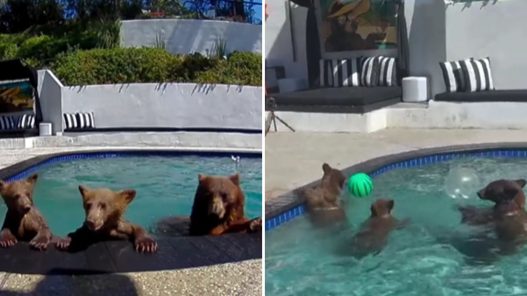
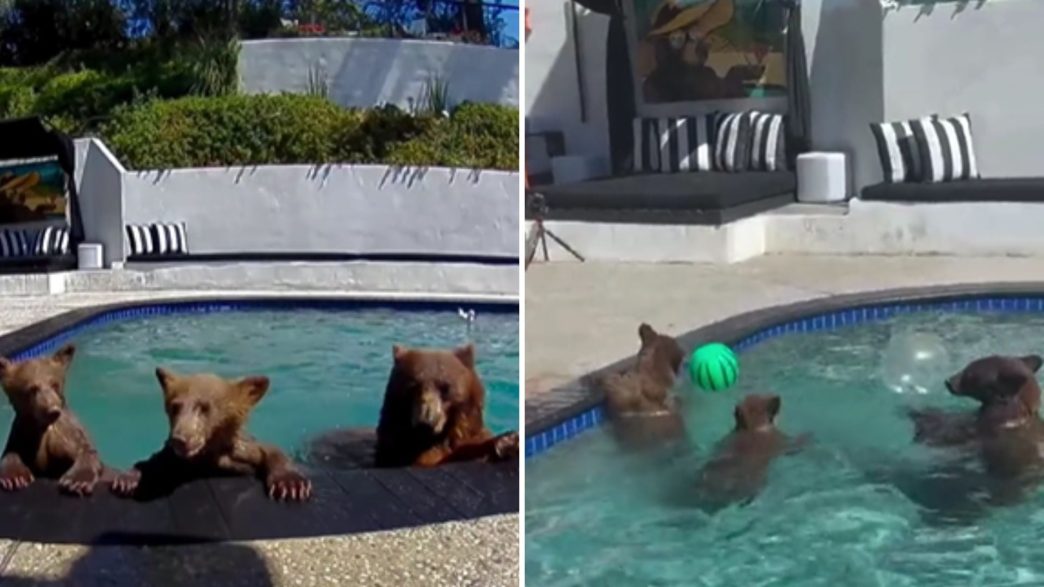
A couple from Monrovia, California, has lived for years with a family of black bears that frequently visit their yard and pool.
Brian Gordon and Ricardo Martínez, residents of an area adjacent to the Angeles National Forest, have recorded the bears entering their property through videos that show the animals playing and resting in the water. Initially, Gordon was concerned for his safety upon learning of the bears’ presence on the property he was about to buy, but over time, his fear transformed into cautious coexistence.
The bears tend to visit several times a week. According to Gordon, they’re fine with the bears using their pool to cool off as long as they don’t try to enter the house or rummage through the trash. At first, the couple used noisy methods to scare them away, but eventually adopted a less aggressive strategy, choosing to stay indoors during the bears’ visits.
Among the bears that visit the property are Maddie, Punky, and Nappy. Maddie is a bear that was first seen in 2023 and has returned with her cubs. Punky, a young female, is known for playing with pool floats. Meanwhile, Nappy has the peculiarity of sleeping in the pool with his head resting on the steps. Videos of these encounters have been shared through the Instagram account @poolbearlife.
California is home to over 60,000 black bears, with around 1,600 in the Monrovia area, a figure that highlights the increasing interactions between humans and wildlife. Researcher Wilson Sherman from the University of California, Los Angeles, points out that these bears are adaptable creatures that often seek food in urban areas, a phenomenon that has also been documented in recent studies.
The coexistence between the couple and the bears raises the need to establish boundaries. Sherman warns that while social media can humanize these animals, it is important to remember that they remain wild. Restricting access to trash and outdoor food is crucial to avoid conflicts. Gordon and Martínez assert that their experience should not be seen as a model, but rather as a particular adaptation to their environment, promoting safe practices in light of the growing coexistence between humans and bears.
Source: www.infobae.com