

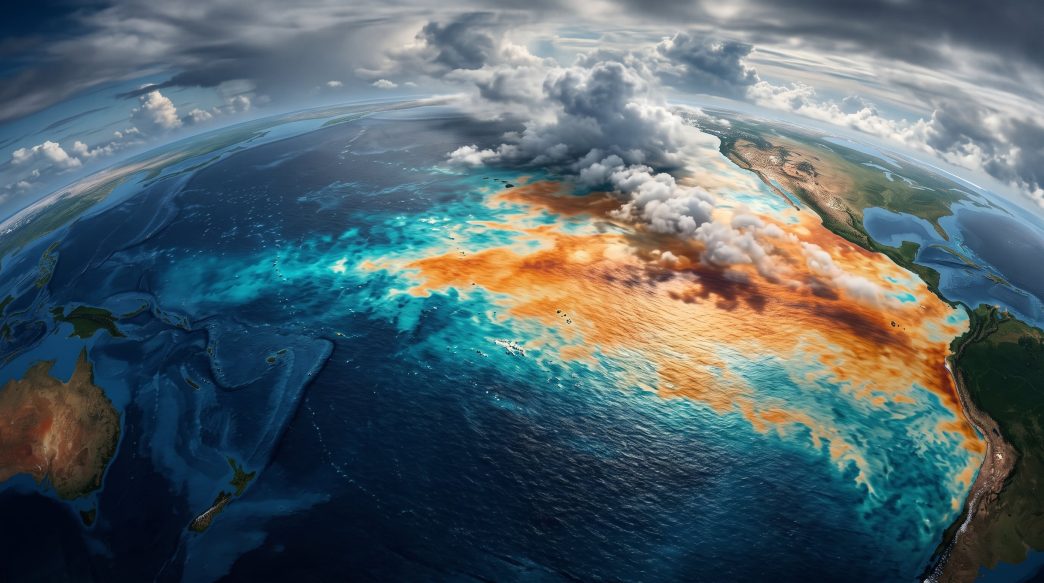
The intensification of El Niño to a very strong category could impact global climate until 2027, according to the World Meteorological Organization (WMO). This climatic phenomenon influences rainfall and temperatures in different regions of the world, increasing the likelihood of extreme events.
Celeste Saulo, Secretary-General of the WMO, warned that “El Niño has the potential to deal a heavy blow to communities and economies around the world.” The devastation from droughts and floods could worsen as the phenomenon intensifies.
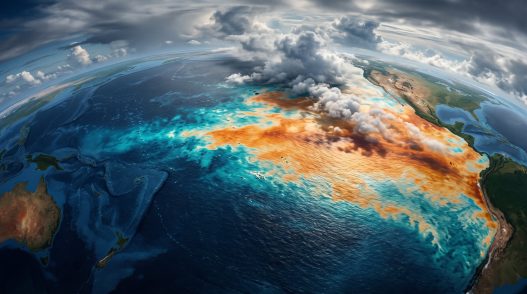
El Niño refers to the anomalous warming of the central and eastern waters of the equatorial Pacific and is part of the El Niño-Southern Oscillation (ENSO) system. This phenomenon alters both the ocean and the atmosphere, influencing air circulation and generating changes in climate patterns.
According to experts, the ENSO has three phases: El Niño, neutral, and La Niña. This phenomenon is not a constant event and occurs every two to seven years, with variations in its intensity and duration. It also gives rise to the opposite phase, La Niña, characterized by an unusual cooling of Pacific waters.
The disruption in the Pacific affects global climate due to the interconnection between the ocean and the atmosphere. An increase in ocean temperature can alter atmospheric circulation and modify rainfall and temperature patterns in distant regions. This phenomenon is considered one of the main regulators of global climate variability, highlighted the WMO and NOAA.
Madelón, a meteorologist, explained that the Humboldt Current, which carries cold water along the South American coast, is affected by El Niño. When the trade winds cease, warm water flows back to the coast, causing storms and heavy rains in desert regions.
The effects of El Niño vary by country and region. It can lead to intense rains, droughts, heatwaves, and agricultural problems. In Latin America, certain areas may experience heavy precipitation, while others could face droughts and water shortages.
The WMO recently warned that El Niño could intensify further, affecting global climate patterns, with a peak expected in late 2026. This could increase the risk of floods, droughts, and heatwaves in various regions of the world.
Although El Niño is a natural phenomenon, global warming intensifies its potential consequences, with extreme rains and droughts creating greater difficulties for populations and food production. In Argentina, a wetter future is anticipated, especially in areas linked to large basins.
Source: www.infobae.com