


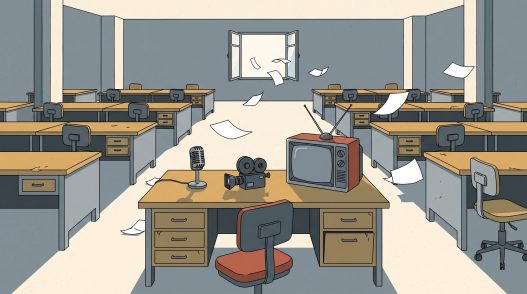
The University of Havana has launched an extraordinary call for students from other fields who are interested in transferring to Journalism for the 2026-2027 academic year. This initiative, announced on September 2 by the Faculty of Communication, arises from the difficulties in attracting professionals in the media aligned with the Cuban regime.
The call is aimed at university students who wish to change their academic focus to Journalism. Applicants must take an aptitude test scheduled for September 11 and 12, which will evaluate general culture knowledge, current information, writing skills, and language proficiency. The number of available spots and how many students are expected to be admitted has not been specified.
José Raúl Gallego, an independent journalist, noted that this decision occurs in a context where the official media system faces challenges in attracting and retaining Journalism graduates. According to Gallego, the profession has lost appeal among young people due to factors such as emigration, low salaries, censorship, and political differences with state-run media. “The quantity and quality of enrollments for the Journalism degree is increasingly lower,” he stated.
Gallego also observed that many graduates choose not to work in official newsrooms or leave them after a period of time. “The media is empty, even the national ones,” he added. This phenomenon not only affects the influx of new students but also the professional practice after academic training, as many graduates encounter obstacles to develop their careers within the official structure.
Among the factors he mentioned, he pointed out the requirement for ideological allegiance to the Cuban political system, which has taken precedence over academic criteria. Additionally, he referred to the imposition of mandatory military service for women selected to study Journalism, which particularly affects a group that used to have greater representation in classrooms, suggesting that this seeks to reinforce political control over future communicators. Gallego argued that the problem is systemic, stating, “it is increasingly difficult to be part of a system that forces you to lie publicly.”
The journalist recalled that the University of Havana implemented a similar process in the 2009-2010 academic year, coinciding with the conclusion of his studies, which received the backing of the Ideological Department of the Central Committee of the Communist Party of Cuba (PCC). On that occasion, the enrollment and graduation of new students was regarded as a “political task.” According to Gallego, the return of this mechanism more than 15 years later indicates that the difficulties in attracting and retaining students have not been overcome.
Source: www.infobae.com